Alien Invader Replacement
Replacing invasive species with indigenous ones
By Lauren van Wensveen
Many Alien Invader Plants (AIPs) have been introduced from other countries into South African gardens. While they look beautiful, these species often multiply at a ferocious rate and, even worse, they quickly out-compete indigenous plants, causing natural vegetation to disappear. In order to protect our fragile ecosystem, these alien invaders should be removed.
However, we also want to have beautiful gardens. Fortunately many indigenous plants are also quite beautiful and can make a great replacement for aliens. Below is an overview of the most common and/or harmful alien invaders, along with suggestions on what to replace them with in your garden.
Rambling Cassia (Senna bicapsularis)
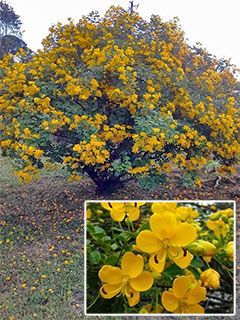
Why it is harmful: scrambles over and competes with other species. Poisonous to birds and bees.
Why people plant it: mainly for hedging and ornamental purposes (big, pretty yellow flowers).
Indigenous replacement suggestion/s:
For hedging:
Several South African shrubs native to KwaZulu-Natal are well-suited for hedging, including:
- Myrtle-leaved Polygala (Polygala myrtifolia): this shrub is common in KwaZulu-Natal and can thrive in various habitats, including dunes, rocky slopes, and forests. It's known for its dense foliage and relatively easy maintenance, making it a good choice for hedging.
- Cape Plumbago (Plumbago auriculata): this fast-growing shrub is known for its lush foliage and showy flowers, making it a beautiful and functional hedge. It's drought-tolerant and can be easily propagated from cuttings or suckers.
- African Box (Buxus macowanii): this evergreen shrub is a good choice for formal hedges, providing a dense and tidy appearance. It's native to the coastal belt and inland areas of KwaZulu-Natal.
- Mackaya (Mackaya bella): this shrub or small tree can be found in KwaZulu-Natal, often along streams and in evergreen forests. It can make a good hedge if pruned appropriately.
- Coastal Hibiscus (Hibiscus tiliaceus): while a larger shrub, it can be used for hedging in larger gardens or as a screen. It's common in coastal areas of KwaZulu-Natal.
For ornamental use:
- Canary Creeper (Senecio tamoides): vigorous fast-growing climber with semi-succulent stems and leaves (needs support to climb). The wonderfully bright canary yellow daisy flowers are borne massed in clusters during late summer and autumn. There is also a variegated version of this plant.
- Wild Laburnum, Natal / Cape Laburnum (Calpurnia aurea): multi-stemmed shrub or small graceful slender evergreen tree. With decorative foliage, showy yellow flowers and a graceful habit, this plant is an asset in any garden. This plant tolerates salty air, humidity and the milder winters of KZN coastal areas.
- Monkey Pod (Senna petersiana): fairly hardy, deciduous shrub or small tree with attractive feathery leaves and grey-brown fissured bark. It bears massed spikes of scented, yellow flowers from February to April. Has a very cassia-look, but is indigenous and grows well in KZN coastal areas.
Peanut Butter Cassia (Senna didymobotrya)
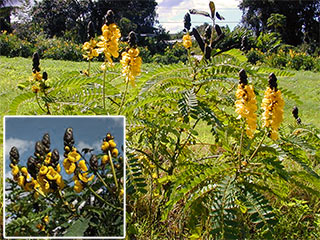
Why is it harmful: scrambles over and competes with other species. Leaves are poisonous.
Why people plant it: mainly for hedging and ornamental purposes (racemes of small, bright yellow flowers).
Indigenous replacement suggestion/s:
For hedging:
Several South African shrubs native to KwaZulu-Natal are well-suited for hedging, including:
- Myrtle-leaved Polygala (Polygala myrtifolia): this shrub is common in KwaZulu-Natal and can thrive in various habitats, including dunes, rocky slopes, and forests. It's known for its dense foliage and relatively easy maintenance, making it a good choice for hedging.
- Cape Plumbago (Plumbago auriculata): this fast-growing shrub is known for its lush foliage and showy flowers, making it a beautiful and functional hedge. It's drought-tolerant and can be easily propagated from cuttings or suckers.
- African Box (Buxus macowanii): this evergreen shrub is a good choice for formal hedges, providing a dense and tidy appearance. It's native to the coastal belt and inland areas of KwaZulu-Natal.
- Mackaya (Mackaya bella): this shrub or small tree can be found in KwaZulu-Natal, often along streams and in evergreen forests. It can make a good hedge if pruned appropriately.
- Coastal Hibiscus (Hibiscus tiliaceus): while a larger shrub, it can be used for hedging in larger gardens or as a screen. It's common in coastal areas of KwaZulu-Natal.
For ornamental use:
- Canary Creeper (Senecio tamoides): vigorous fast-growing climber with semi-succulent stems and leaves (needs support to climb). The wonderfully bright canary yellow daisy flowers are borne massed in clusters during late summer and autumn. There is also a variegated version of this plant.
- Wild Laburnum, Natal / Cape Laburnum (Calpurnia aurea): multi-stemmed shrub or small graceful slender evergreen tree. With decorative foliage, showy yellow flowers and a graceful habit, this plant is an asset in any garden. This plant tolerates salty air, humidity and the milder winters of KZN coastal areas.
- Monkey Pod (Senna petersiana): fairly hardy, deciduous shrub or small tree with attractive feathery leaves and grey-brown fissured bark. It bears massed spikes of scented, yellow flowers from February to April. Has a very cassia-look, but is indigenous and grows well in KZN coastal areas.
Easter Cassia (Senna pendula)
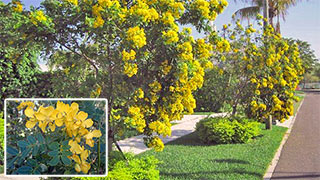
Why it is harmful: scrambles over and competes with other species. Poisonous.
Why people plant it: mainly for ornamental purposes (bright yellow flowers, prevalent throughout the year).
Indigenous replacement suggestion/s:
- Canary Creeper (Senecio tamoides): vigorous fast-growing climber with semi-succulent stems and leaves (needs support to climb). The wonderfully bright canary yellow daisy flowers are borne massed in clusters during late summer and autumn. There is also a variegated version of this plant.
- Wild Laburnum, Natal / Cape Laburnum (Calpurnia aurea): multi-stemmed shrub or small graceful slender evergreen tree. With decorative foliage, showy yellow flowers and a graceful habit, this plant is an asset in any garden. This plant tolerates salty air, humidity and the milder winters of KZN coastal areas.
- Monkey Pod (Senna petersiana): fairly hardy, deciduous shrub or small tree with attractive feathery leaves and grey-brown fissured bark. It bears massed spikes of scented, yellow flowers from February to April. Has a very cassia-look, but is indigenous and grows well in KZN coastal areas.
Sword Fern
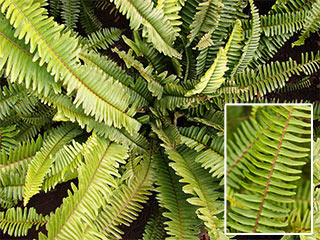
In South Africa, the plants commonly referred to as "sword fern" are primarily two species from Nephrolepis, both of which are considered invasive due to how they displace indigenous ferns and other forest-floor species:
- Nephrolepis cordifolia
- Nephrolepis exaltata
Why it is harmful:
- Spreads extremely easily. Sword ferns reproduce in three different
ways, making it very hard to control:
- Spores (carried by wind, so they spread far)
- Stolons (creeping runners that root and form new plants)
- Underground tubers (which allow it to regrow even after being pulled out)
- Forms dense, smothering mats which block sunlight from reaching the soil, preventing germination of native seeds and inhibiting the growth of local understory plants. This reduces plant diversity and alters natural plant communities.
- Thrives in many environments and is tolerant of shade, full sun, drought, high rainfall and coastal humidity. This makes it particularly successful in places like KwaZulu-Natal, especially the wetter coastal areas.
- Has no natural predators or diseases in South Africa. In its native range in Asia and the Pacific, herbivores and pathogens keep it under control. In South Africa, those checks are missing.
Why people plant it: Nobody really plants it anymore - it plants itself!!
How to remove:
Because of the way swordferns reproduce, removal has to be done properly. Improper handling will cause it to spread even quicker! Dig out the entire plant and make sure to get as much of the tuberous root system as possible. Place the removed ferns in a tightly closed black plastic bag and let them sit in the sun for at least four weeks before disposing of them.
Indigenous fern alternative replacement suggestion/s:
- Shield Ferns (Polystichum): a classic woodland fern. Common
species found in South Africa include:
- Polystichum incongruum: forest shield fern (Eng.); woud skildvaring (Afr.)
- Polystichum luctuosum: mourning shield fern (Eng.); treur skildvaring (Afr.)
- Polystichum macleae: McLea's shield fern (Eng.): oostelike skildvaring (Afr.)
- Polystichum monticola: mountain shield fern (Eng.); berg skildvaring (Afr.)
- Polystichum pungens: forest shield fern (Eng.); woud skildvaring (Afr.)
- Polystichum transvaalense: stemmed shield fern (Eng.); enkelstam skildvaring (Afr.)
- Soft, lacy fronds similar to sword fern
- Ideal for shaded, forest-like parts of the garden
- Tolerant of moisture but handles brief dryness
- Leatherleaf Fern (Rumohra adiantiformis): common in indigenous
forests. Benefits:
- Hardy, easy to grow
- Tolerates dry shade
- Similar form to some garden sword ferns
- Evergreen and low-maintenance
- Maidenhair Fern (Adiantum capillus-veneris): light, delicate and surprisingly tough in coastal conditions. Best for walls, pots, mossy shaded areas as well as gardens with constant moisture.
- Asparagus Ferns (Asparagus spp.) — NOT the invasive ones.
Several indigenous asparagus species make excellent fern-like
groundcovers. Recommended species:
- Asparagus densiflorus "Meyeri" (Foxtail fern / Cat's Tail asparagus)
- Asparagus densiflorus "Sprengeri"
- Asparagus africanus (climber, feathery foliage)
- Drought tolerant
- Lush and soft-looking
- Tolerates sun or shade
- Hardy in the coastal belt
Recommendations based on varying garden conditions in coastal KZN:
Shady & moist:
- Adiantum capillus-veneris
Shadier & drier:
- Rumohra adiantiformis
- Polystichum varieties
Sun–semi-shade / tough spots:
- Asparagus densiflorus varieties
Goosefoot Vine (Syngonium podophyllum)
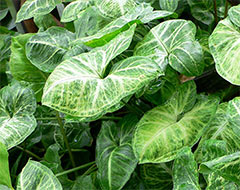
Also known as Arrowhead Plant or Arrowhead Root.
Why it is harmful:
- Habitat disruption: smothers native undergrowth with its dense ground cover and can make forest trees top-heavy, making them susceptible to wind damage.
- Spreads easily: reproduces vegetatively from plant fragments, which is the primary way it spreads in the wild. It can also be spread by cuttings.
Why people plant it: popular as an ornamental house and garden plant, but when planted outdoors in warmer regions, it escapes cultivation and becomes a serious threat.
Indigenous replacement suggestion/s:
Glossy Forest Grape / Glossy Wild Grape / Ropewood (Rhoicissus rhomboidea) Afrikaans name/s: blinkblaarbosdruif, bimbrikos, bobbejaantou; Zulu name: isinwazi.
Why this is the closest indigenous equivalent:
- It is a forest-dwelling, shade-loving climber, just like Syngonium.
- Works exceptionally well as an indoor houseplant.
- Has soft-textured, shiny leaves with a tropical appearance.
- Young leaves often have a slightly arrow-shaped or rhomboid form, giving a similar visual feel.
- It climbs gently and can trail or be trained up a support.
- Very tolerant of indoor light conditions.
- It's commonly used as a houseplant in South Africa but many people don't realise it is a native forest species.
Mexican Sunflower (Tithonia diversifolia)
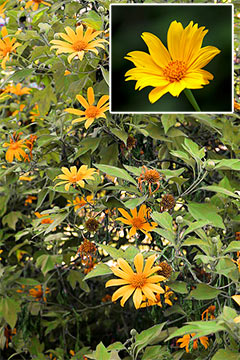
Why it is harmful:
- Aggressive growth: grows rapidly and can reach up to 5 meters tall, outcompeting native plants for space.
- "Monoculture" formation: it's allelopathic properties allow it to create dense stands that prevent native species from growing.
- Efficient reproduction: reproduces through wind-dispersed seeds and vegetative means (e.g., cuttings), making it highly aggressive and difficult to control.
- Widespread distribution: has established itself in tropical and subtropical provinces like Limpopo, Mpumalanga and KwaZulu-Natal, and is also found along roadsides and railway lines.
Why people plant it:
- Ornamental house and garden plant.
- Used by some farmers for "green manure" (but its negative impacts on native vegetation, mobility, water availability and crop yields are now considered to outweigh the benefits).
Indigenous replacement suggestion/s:
For ornamental use:
- There are many indigenous plants which are more beautiful and safe for the environment, so visit The Plant Library / Coastal KZN region to choose from a large number which grow well in the coastal KZN area.
For green manure the best alternatives that work well as soil-builders or cover crops in coastal KwaZulu-Natal are:
- Indigenous Crotalaria species (rattlepods):
- Crotalaria capensis (Cape rattlepod)
- Crotalaria sphaerocarpa
- Crotalaria natalitia (Natal rattlepod — perfect for KZN)
- Crotalaria agatiflora
- Indigofera species:
- Indigofera frutescens
- Indigofera natalensis (naturally occurring only in KZN and the Wild Coast area of EC)
- Indigofera cylindrica
- Desmodium species (tick-trefoils)
- Desmodium repandum
- Desmodium triflorum
- Vigna vexillata (Wild cowpea)
Ageratum
Specifically: Ageratum conyzoides (invading ageratum) and Ageratum houstonianum (Mexican ageratum).
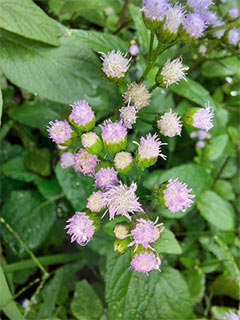
Why it is harmful:
- Rapid and prolific seed production: produces a high number of small seeds that are easily spread, allowing it to colonize new areas quickly.
- Multiple dispersal methods: seeds can be dispersed by wind, water, animals and people through contaminated clothing, vehicles and agricultural produce, which is how it spreads to new habitats.
- Aggressive growth: grows aggressively and spreads by producing thousands of plantlets, often outcompeting indigenous vegetation.
- Colonization of disturbed areas: readily colonizes agricultural lands, wastelands, roadsides and riverbanks, which are areas that are often disturbed by human activity.
- Toxicity: some species are toxic to livestock, making them a threat to animals that graze in infested areas.
- Impacts on native ecosystems: can negatively affect biodiversity, cause crop yield reductions and act as a host for pathogens that affect crops
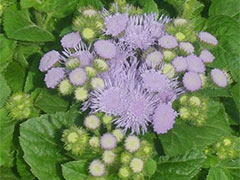
Why people plant it: grown for its whimsical pompom-shaped flowers that occur mostly in shades of blue, though other colours include white, pink, lavender, and red.
Indigenous replacement suggestion/s:
Pompon tree / Pincushion tree (Dais cotinifolia) Afrikaans name/s: kannabas, speldekussing, basboom; Zulu name/s: intozwane-emnyama.
- Bears masses of very showy, fragrant pink, pom-pom like flowers that attract a whole host of birds and insects from November to February (begins flowering whilst still young).
- Very hardy, fast growing, deciduous, small tree with attractive slightly blue green leaves.
- Sun or semi-shade.
- Ideal for small gardens and containers.
Bamboo
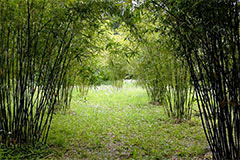
Bamboo comes in two major species: clumping bamboo and running bamboo.
Clumping bamboo is non-invasive. It has "pachymorph" rhizomes that grow vertically, causing new shoots to emerge in a tight cluster. Some clumping species, like Bambusa balcooa, are cultivated commercially and are not considered invasive because they don't spread via runners and may not even produce viable seeds.
Running bamboo is invasive. As a general rule, if you encounter bamboo that does not grow in tight, isolated clusters or you see new shoots popping up everywhere, it is almost certainly the invasive variety. Running bamboo has "leptomorph" rhizomes that grow horizontally underground, spreading rapidly and invading large areas.
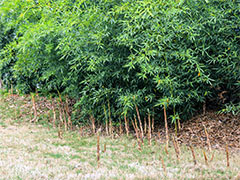
Running bamboo is very hard to eradicate. The rhizomes can easily pass underneath garden walls and other barriers. The main options for removal are:
- Consistent long-term effort to exhaust its underground rhizome system through frequent cutting;
- Physical removal by digging out the rhizomes
- As a last resort: targeted herbicide application. In this case a systemic "paint-on" herbicide should be used rather than spraying.
The most effective approach without using herbicides involves cutting the bamboo to the ground, then digging out the rhizomes to a depth of at least 50cm. Alternatively one can try repeatedly cutting new shoots repeatedly to starve the plant over 2–4 years, but this is less effective and requires frequent attention. Make sure to mark the location of the cuttings so they can easily be found later for re-cutting.
Why people plant it: mainly for aesthetic and practical purposes, like creating wind breaks, noise barriers, or to form living fences. (And then they wish they hadn't, when it takes over the entire garden!)
Indigenous replacement suggestion/s:
South Africa only has one native bamboo species, Bergbambos tessellate, but this is not easy to find for purchase.
Bambusa balcooa (also known as giant bamboo) is a naturalized species in South Africa, introduced in 1660. It is a clumping bamboo, meaning it forms dense clumps instead of spreading via runners, and is considered non-invasive. This bamboo thrives in various South African climates, including KwaZulu-Natal, Mpumalanga, Gauteng, Eastern Cape and Western Cape Provinces.
For tall wind breaks (3-10m) and noise barriers:
- Tree Fuchsia (Halleria lucida)
- Height: 3–10m
- Benefits: dense foliage, fast-growing, excellent wind buffer; also attracts birds and beneficial insects with masses of orange tubular flowers.
- Dune Crowberry (Searsia crenata)
- Height: 2–5m
- Benefits: excellent coastal windbreak, dense and salt-tolerant
- Coastal Silver Oak (Brachylaena discolor)
- Height: 3–10m
- Benefits: very wind- and salt-hardy, fast-growing; one of the best coastal windbreaks in SA
For medium wind breaks (1-6m) and security barriers:
- Bladdernut (Diospyros whyteana)
- Height: 2–6m
- Benefits: naturally forms a very dense, neat hedge
- Num-num / Natal Plum (Carissa macrocarpa)
- Height: 1.5–3m
- Benefits: spiny, dense, excellent security barrier (also has edible fruit)
- Forest num-num (Carissa bispinosa)
- Height: 1–2m
- Benefits: smaller cousin to Carissa macrocarpa, very dense and thorny
- Dogwood / Blinkblaar (Rhamnus prinoides)
- Height: 2–5m
- Benefits: fast-growing, excellent for hedging
Lantana (Lantana camara)
Why it is harmful:
- Ecological damage: outcompetes and replaces native species, interrupting natural regeneration processes and reducing overall biodiversity.
- Livestock poisoning: is a common cause of livestock poisoning, leading to significant economic losses each year due to animal deaths.
- Reduced agricultural productivity: forms dense thickets that reduce grazing potential and obstruct access to land and water sources.
- Spread: spreads rapidly, often dispersed by birds that eat its berries.
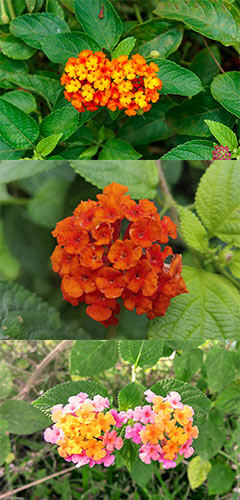
The colors of the Lantana flowers can vary. Depending on where it grows and how long ago the flowers opened they can be yellow, orange, red, magenta, pink or white, of any combination thereof.
Lantana can cause skin irritation, so wear gloves when handling it!
Why people plant it: mainly for ornamental purposes as it is known for its vibrant, multi-colored flowers.
Indigenous replacement suggestion/s:
- Pride of the Cape (Bauhinia galpinii)
- Height: up to 3m
- Dense, sprawling shrub with brick-red flowers that attracts birds and insects
A final note
There are many indigenous plants which are more beautiful and safe for the environment, so visit The Plant Library / Coastal KZN region to choose from a large number which grow well in the coastal KZN area.
More information on alien invader plants and how to deal with them can also be found on our AIP Awareness pamplets.