NOTE: not all images have finished loading. Please cancel printing, wait a few moments and try to print again. All images should then be visible.
The Great Backyard Bird Count (GBBC) Project
By Samantha Prigge (photos by Gert de Koker)
NOTE:
The next upcoming birding event is:
- Great Backyard Bird Count: 12-15 February 2027
Conservancy members who would like to participate should contact Samantha Prigge via our WhatsApp Group.
The Munster and Palm Beach Conservancies recently participated in the Great Backyard Bird Count (GBBC), a global project initiated by the Cornell Lab of Ornithology. The Cornell Lab is a non-profit science and conservation organisation and unit of Cornell University"s College of Agriculture and Life Sciences. The GBBC was one of the first online projects to collect information on wild birds and was instrumental in the creation of eBird in 2002. eBird is now among the world"s largest biodiversity-related science projects, with more than 100 million bird sightings contributed annually by eBirders around the world.
Apart from providing an opportunity to appreciate the abundance and diversity of birds to be found along this strip of coastal paradise, the GBBC offered members of our local Conservancies a chance to contribute to global research on bird numbers, movements and general behaviour. Citizen science has become increasingly popular, methodical and rich in knowledge since the worldwide accessibility of initiatives such as iNat and eBird. The focus of such initiatives is on using participatory projects, broad partnerships and practical actions to enhance conservation efforts. As eBird states, they transform "the global birding community's passion for birds into a powerful resource for research, conservation, and education".
The GBBC is a project aimed at mobilising the daily experience of birders from around the world, and in particular the observations being made in their backyards: either their own residential garden, or in surrounding parks, gardens, and greenbelts. The central idea is to keep it local, to observe and map common residents as well as uncommon visitors and migrants. Any and all sightings, whether made incidentally while doing something else, or made during a dedicated birding session, are permissible. And the familiar patterns of territorial and sedentary birds are as important as sightings of unfamiliar birds.
So how did the Munster and Palm Beach Conservancies fair over the 4-day event? Below is a summary of some key data from our shared observations.
(**)Sound recordings available on the eBird Trip Report.
Because of its biodiversity - with environments ranging from grassland to dune forest, coastal bush to riverine thicket, and suburban garden to shoreline - Munster is home to a vast diversity of bird species. It is also a potential stop-over and breeding ground for many migrant birds. Birds identified over the 4-day event included:
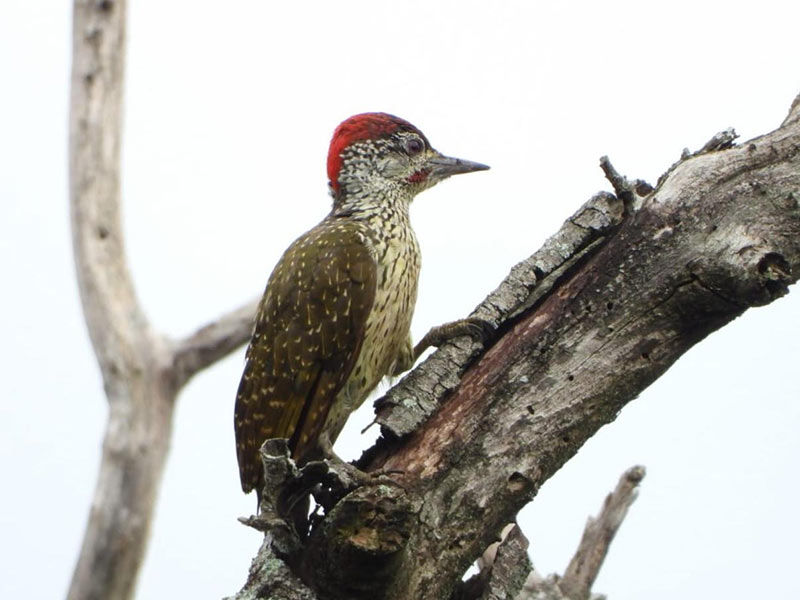
- Insectivores such as the Golden-tailed Woodpecker, African Pied Wagtail and African Palm Swift - an aerial eater that is unable to perch, using its tiny legs with hook-like claws to cling to the undersides of palm fronds;
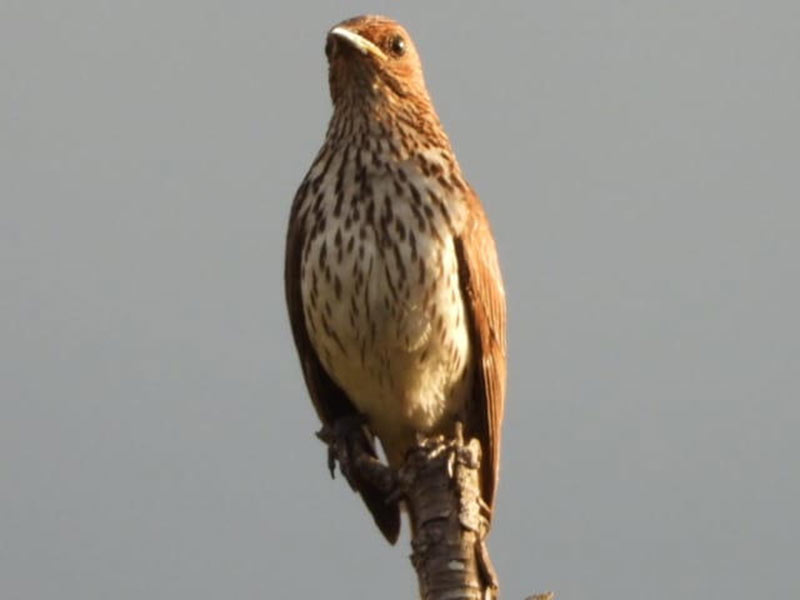
- Frugivorous or fruit-eating birds such as the Purple-crested Turaco and Trumpeter Hornbill;
- Granivorous or seed-eating birds such as the Red-backed Mannikin and Red-eyed Dove;
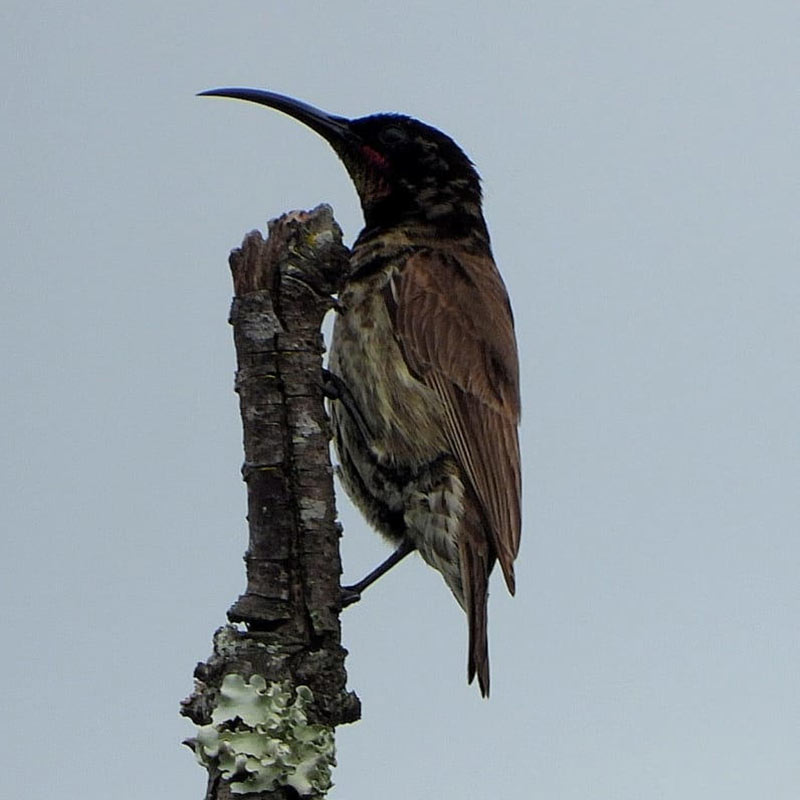
- Nectar-feeders such as the Collared Sunbird, Olive Sunbird and Amethyst Sunbird;
- Piscivorous birds or fish-eating raptors such as the Fish Eagle, White-breasted Cormorant and Pied Kingfisher;
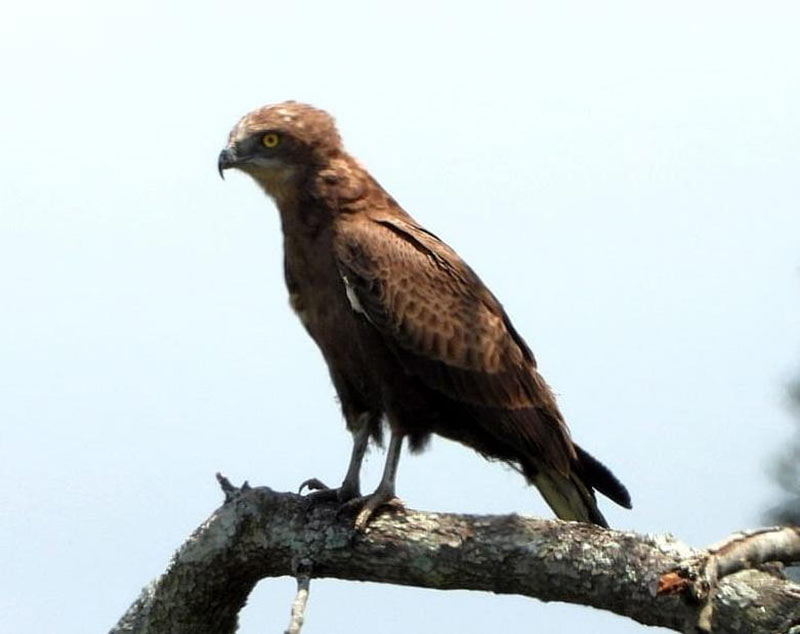
- Carnivorous or meat-eating raptors such as the Brown Snake Eagle and Common Buzzard;
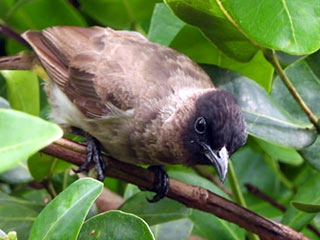
- Omnivores who are more opportunistic and eat a combination of fruits, plant- and animal-matter, such as the White-Eared Barbet (known to eat wasps, locusts and dragonflies as well as figs and berries), the Yellow-rumped Tinkerbird (feeds on figs and mistletoe fruits, as well as termites, ants, moths and beetles), the Dark-capped Bulbul (eats almost any fruit, nectar, seeds and flower parts, as well as beetles, aphids, mantids and even small geckoes), the Red-winged Starling (fruit including that of invasive species as well as molluscs, insects, frogs, spiders, and scorpions) the Yellow-billed Duck (feeds on aquatic plant parts as well as molluscs, crustaceans and insect larvae).
Some of the species observed during the 4-day event are far-ranging within the Munster area, travelling between shoreline and woodland, grassland and riverine thicket, or between different bodies of water. Others are more localised and likely to be seen nesting, breeding, foraging and feeding in a very specific habitat, possibly even defending a single fruiting tree. Many are resident, territorial and monogamous species and were thus seen more than once in the same day in the same area and over an extended period of time. The total number of birds counted thus included repeat sightings of such birds (refer to table above).
This was especially true of a small familial group of White-Eared Barbets that would congregate every morning around 5.30am on the same stark branch at the top of a Grevillia robusta (Silky Oak), calling and chattering briefly before flying off to start foraging. The high number of White-eared Barbets counted during the GBBC (over 40) is therefore not a demonstration of the abundance of the species in the area overall but, in this case, an indicator of a small group"s routine behaviour and prevalence in a specific location. This could also be an accurate explanation for the high number of Red-eyed Doves (over 30) and Black-headed Orioles (19) counted, with monogamous pairs seen or heard calling from the same or similar perches on a daily basis and often throughout the day. The rather elusive Buff-spotted Flufftail, although counted nearly 10 times, appeared to be a single bird calling from the same area both at dawn, dusk and sometimes throughout the night. The male is known to do this predominantly (possibly even exclusively) during the breeding season.
Some birders who have over many months or years observed the activity in their backyards, noted that their lists for the weekend did not match up to the number and diversity of birds commonly spotted on their home turf. The rainfall and general weather conditions over the weekend may have contributed to this. Nevertheless, our shared efforts placed Munster on eBird"s list of top hotspots in KwaZulu-Natal.
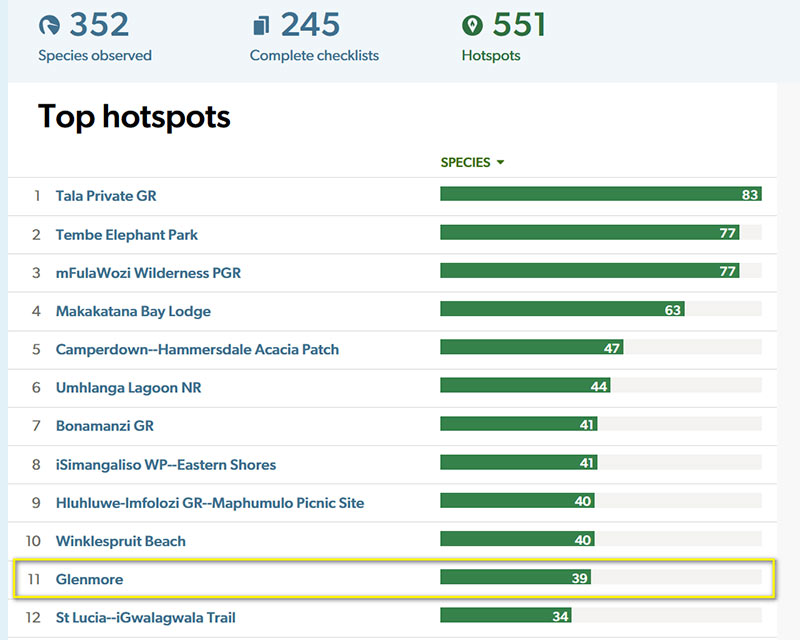
(An interesting historical and technical side-note on the naming for our Munster Conservancy sightings - Glenmore had already been identified on the eBird map as a birding location based on the sightings of an individual ebirder many years ago who is no longer resident in the area. This mapped location has become the default spot for all the sightings under my personal eBird profile. As the GBBC 2026 was my first-time facilitatinga group event on eBird, I opted to use this existing location as the overall "catchment area" for our observations, simply adding several "backyard locations" specific to participating birders.)
It was pleasing to see that KwaZulu-Natal featured well as a province overall on the GBBC with 352 species identified. Interesting to note is the ratio between this number of species and the number of checklists submitted - possibly pointing to the diversity of bird life in KZN with less checklists yielding more species.
Why is the participation of Munster Conservancy in this global, online, biodiversity project so important? This statement sums it up quite clearly: "Protecting birds and their habitats in one region may be of little help if their breeding areas or overwintering grounds on the other side of the Earth are not conserved". For instance, one of the birds spotted on our GBBC, the Marsh Warbler, breeds across the temperate belt of Europe to Central Asia and winters here in southeastern Africa. As birdwatchers, conservationists and citizen scientists, when we observe the movements and behaviour of birds, we become more aware of the interconnectedness of the world's ecosystems and the necessity of teamwork between individual landowners, neighbouring environments, nations and continents. Migrating birds may have key stopover sites and staging areas in our area that need protection.
Another example to illustrate this is the Buff-spotted Flufftail. As birdsoftheworld.org explains: "Our knowledge of this species' biology and ecology, especially breeding and foraging behavior, is almost entirely based on detailed studies in KwaZulu Natal, in eastern South Africa, and to a lesser extent elsewhere across the southern Africa subregion, with almost nothing been recorded elsewhere". Based on its distribution range across south-eastern to central Africa, it is probable that this bird is a migrant, but our knowledge of the extent and nature of these movements remains limited. Whether it is across provinces, nations and continents, or across small neighbouring conservation areas, the impact of counting and mapping the movements of birds can not be underestimated.
The GBBC was the first in what is hoped will be many future birding events to bring the passion, efforts and expertise of members of Munster Conservancy, and neighbouringConservancies, together. To build momentum in preparation for the GBBC 2027 which is scheduled for February 12-15, 2027 - also marking the 30th Anniversary of GBBC - the Munster Conservancy Birding group on WhatsApp (facilitated by Samantha Prigge) will stay active throughout the year. Members who would like to contribute their observations on a regular basis, or improve their knowledge of local birds, are welcome to join at any time.
You can also view the full Trip Report of our 4-day participation, including full lists of birds, photographs and sound recordings on eBird.