Rainwater Harvesting Made Simple
By Frank van Wensveen
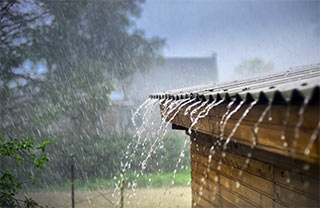 The Dutch have a saying: "De hemel geeft; wie vangt, die heeft."
(Which translates to Afrikaans as "Die hemel gee; wie vang, dié
het" and into English as "Heaven gives; whoever catches it,
has it"). While this mainly refers to the wisdom of catching an
opportunity whenever it presents itself, it is also true in a very
literal sense when it comes to water.
The Dutch have a saying: "De hemel geeft; wie vangt, die heeft."
(Which translates to Afrikaans as "Die hemel gee; wie vang, dié
het" and into English as "Heaven gives; whoever catches it,
has it"). While this mainly refers to the wisdom of catching an
opportunity whenever it presents itself, it is also true in a very
literal sense when it comes to water.
Our water infrastructure continues to deteriorate, and some catchment areas and dams are becoming less effective as rainfall patterns change. An uninterrupted supply of clean tap water is no longer something we can take for granted.
Fortunately Munster has a relatively steady supply of clean rain. Even better: this rain is of high quality! There are no polluting industries or power stations nearby to introduce heavy metals, chemical pollutants or other contaminants that are difficult to remove; most of our rain comes in straight from the ocean. And we get a lot of it:
- One millimetre of rain equals to one litre per square metre;
- Munster receives, on average, over 100mm of rain per month;
- The average measurement for a three bedroom house is 120 to 140 square metres.
That means that every month an average of about 12,000 litres of good quality rain water land on the roof of even a relatively sensibly sized house - absolutely free!
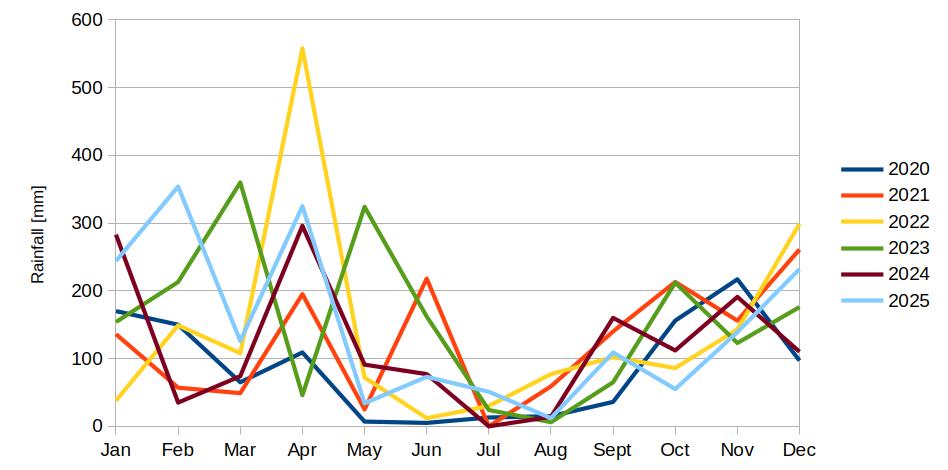
Note, however, that numbers, graphs and trends don't tell the whole story. For example, the average yearly total rainfall from 2000 to 2019 (which is not included in the table and graph above) was 1315 mm. As you can see, the yearly average total rainfall has been going up steadily ever since, with the exception of 2024 which showed a lower figure. This is most likely the result of climate change, but another effect of this is that rainfall patterns are becoming more varied, not to say erratic.
Longer dry periods followed by brief bursts of extremely heavy rainnfall are becoming more common. The graph clearly shows what happened in April 2022. These peaks raise the total amount of rainfall per year, but this does not necessarily benefit us: most of it runs straight into the ocean because neiher the land nor our rainwater capturing tanks can handle that sort of water volume.
Also keep in mind that not every drop of that water can be captured. Very light rain will only wet the roof, and not much of it will run down into the gutters and downpipes before the rain stops and the water evaporates. Trees may overhang parts of the roof, or you may not be able to use the entire roof for practical reasons. But even if one budgets on capturing no more than half of the rain water landing on the roof, the total amount available is still well worth it.
There are different approaches to making the most of this free water supply, depending on one’s needs and budget. The most basic option consists of a water tank, a pump and some simple plumbing hardware. All that is required is to place the tank at a convenient location and divert the downpipe from the gutter into it.
The "Cheap & Cheerful Option"
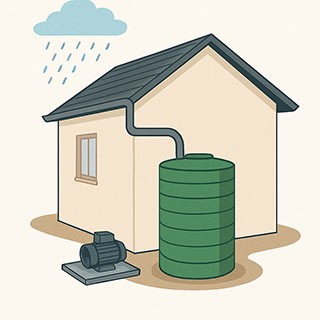 Rainwater harvesting can start with a minimal system that merely
captures the run-off from the gutters. The water will be unpurified and
not suitable for drinking, bathing or washing clothes. However, in
the average mid-income South African household 30–40% of the entire
tap water consumption is used to flush toilets. But we don’t
need purified water to flush the loo; any reasonably clean water will
do!
Rainwater harvesting can start with a minimal system that merely
captures the run-off from the gutters. The water will be unpurified and
not suitable for drinking, bathing or washing clothes. However, in
the average mid-income South African household 30–40% of the entire
tap water consumption is used to flush toilets. But we don’t
need purified water to flush the loo; any reasonably clean water will
do!
This need not be complicated at all: a water tank, a pump, a length of downpipe from the gutter to the tank, and a ball valve (to switch the municipal water back on if the tank runs dry) is enough to start saving significantly on your municipal water consumption. Yes, it really is that simple!
Nor is expensive plumbing necessary: even a length of garden hosepipe, properly attached, will suffice to connect the output of the pump to the water pipe going into the sistern. Optionally an outside tap can be added to fill buckets or to connect a garden hosepipe.
The water coming out of this basic system is more than good enough to flush the toilet, which will reduce your tap water consumption by one third. Yes, it’s that simple! The water will be clear enough: any sediment coming out of the gutter will end up at the bottom of the tank and only the very small particles in suspension will make it into the cistern. Both the tank and cistern should be cleaned periodically (the tank typically once a year; the cistern every one to two months) but that is all. Unpurified rainwater of this quality is also perfectly suitable for washing floors, windows and cars, and of course for watering the garden or potted plants.
Granted, even the simplest rainwater harvesting setup will come with a certain initial capital outlay. However, keep in mind that the system can be extended in the future, at which time all these components will remain service. Nothing will have to be replaced or thrown away.
Of course such a minimal system does have its limitations. Dust and sand will wash off the roof and into the tank. Some dead leaves, twigs, bugs and other organic matter will also end up in the water and start to decompose there. Fortunately some basic and inexpensive measures will eliminate most of this.
Install a Leaf Catcher
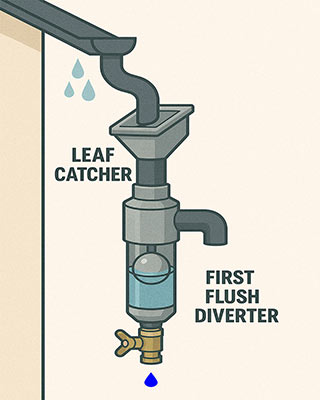
A leaf catcher is a simple screened funnel that keeps leaves, twigs, most bugs and other matter out of the water that goes into the tank. It is inexpensive, easy to install, and will keep a lot of contaminants out of the water. Most of the captured debris will slide off the screen all by itself sooner or later; cleaning the screen is something that typically won’t need to be done more than once every two months or so.
Install a First Flush Diverter
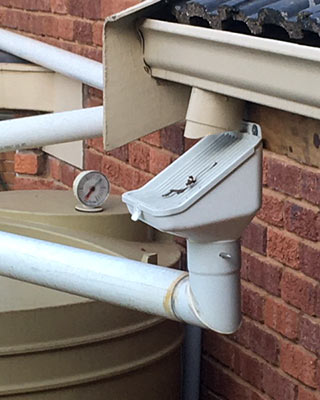
The second step in keeping debris out of the tank is to add a First Flush Diverter. This is just a vertical tube (typically somewhat wider than a standard downpipe) that is installed between the downpipe coming from the leaf catcher and the one going into the tank. The bottom of the pipe is closed with a valve, and inside the pipe is a spherical float.
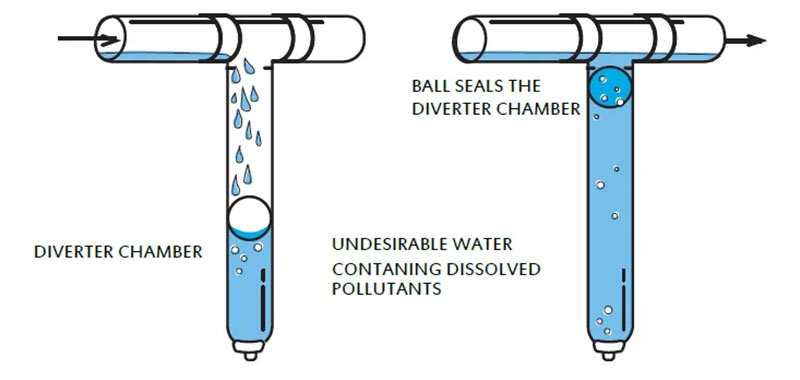
The principle of a First Flush Diverter is based on the fact that when there is no rain, both the roof and the gutter will accumulate sand, dust and other particles that are too small to be stopped by a leaf catcher. When the rain starts, these particles will be washed down from the roof and gutter. Therefore the first runoff will be relatively dirty, but anything after that will be clean water. All we need to do is to prevent the first runoff from going into the tank. This is what the First Flush Diverter does.
 Initially the vertical pipe section (the diverter chamber) is
empty. When the rain starts, the initial dirty run-off coming from the
roof (the "first flush") flows into the diverter chamber, and
the float rises. When the chamber is full, the float reaches the top and
closes the inlet of the chamber. Any subsequent rain water will now flow
past the closed inlet and into the tank.
Initially the vertical pipe section (the diverter chamber) is
empty. When the rain starts, the initial dirty run-off coming from the
roof (the "first flush") flows into the diverter chamber, and
the float rises. When the chamber is full, the float reaches the top and
closes the inlet of the chamber. Any subsequent rain water will now flow
past the closed inlet and into the tank.
The size of the pipe should be large enough so that by the time it is full, most sand and dust will have been washed off the roof. This depends on roof size and local conditions.
Once the rain stops, the valve at the bottom is opened to drain away the dirty water, and the system is ready for the next rain. Alternatively the valve can be opened just a crack (a “weep hole”) so that the pipe slowly drains between showers. However, this creates the risk of dirt clogging the small opening. It will also slightly reduce the amount of water ending up in the tank. The tiny trickle won't make much difference during a good rain shower, but if there is only a little rain then the loss due to the water constantly trickling out of weep hole may become noticeable.
Water Purification
Water coming out of the tank will generally be as clear as the municipal tap water that we are used to. Any solids will settle to the bottom of the tank and only tiny particles will remain suspended in the water. (This is much like the tap water produced by the industrial purification process used in municipal waterworks, where most purification is achieved by precipitating the solid contaminants). However, the water will not be microbially safe and will be unsuitable for drinking. It may also smell a bit musty, as a result of organic breakdown products that may occur in the water.
The simplest and cheapest way to combat microbes in the water and make it safe to drink is chlorination. This is what the municipal water works do after removing all solid contaminants from the water. There are special water purification tablets to add to water tanks, which are "fizzy" so they spread the chlorine through the water quickly and after 15 minutes the water will be safe to drink. However, these tablets are rather expensive and may be hard to find. They also have a disadvantage: the chlorine compound they contain is sodium-based, which may a problem for people who are on a low-sodium diet. Furthermore, the chlorine will evaporate over time, and another tablet will have to be added to the tank periodically.
As a more cost-effective alternative, HTH makes specific chlorine tablets that are marketed as being intended for drinking water purification. The chlorine compound in these tablets is based on calcium rather than sodium, which eliminates sodium-related health concerns. These tablets are not fizzy and must be used in a refillable pool floater that sits inside the tank and releases the chlorine gradually. This makes the chlorine level in the tank difficult to control: it tends to be either too high or too low. Also, refilling the pool floater periodically is cumbersome. However, when one is on a limited budget and doesn’t mind putting a ladder against the tank once a week to check and adjust the amount of dry chlorine in the floater, this will make the water safe to drink, as well as suitable for showering, washing, dish-washing and all other normal household uses.
Regular bleach or pool chlorine can be used on an occasional basis or in an emergency. This is safe enough in a pinch, but these products are also sodium based and are not food grade, so they are not recommended for regular use.
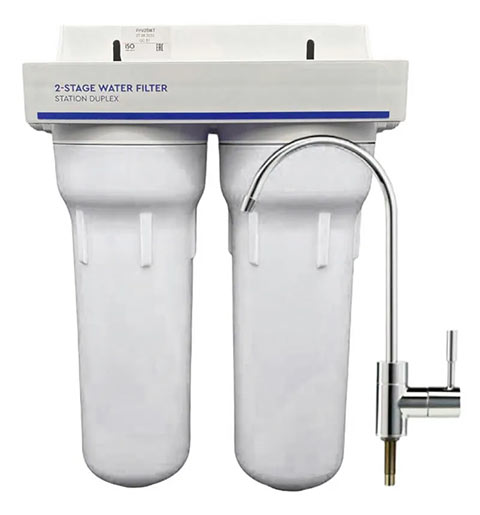 While chlorine alone makes the water safe to use, there may still be
organic breakdown products from moss, leaves, algae etc. present in it,
which results in a slight musty smell and flavour. These can be removed
by filtration. The simplest way to do this is an under-the-counter
filter system consisting of two filters with replaceable filter
cartridges. The first filter is typically a 5 or 10 micron particle
filter made from plastic (known as a “Melted Spray” or “Spray
Blown” filter. (Do not use paper filter cartridges; these are not
intended for this application.) The second filter is typically an active
carbon filter that not only removes the musty smell and flavour from
the water, but also most or all of the chlorine. Active carbon filters
come in two forms: Granulated Active Carbon (GAC) cartridges and Carbon
Block cartridges. The latter is the best option since the granules have
been fused into a porous block. They are slightly more expensive but
significantly more effective.
While chlorine alone makes the water safe to use, there may still be
organic breakdown products from moss, leaves, algae etc. present in it,
which results in a slight musty smell and flavour. These can be removed
by filtration. The simplest way to do this is an under-the-counter
filter system consisting of two filters with replaceable filter
cartridges. The first filter is typically a 5 or 10 micron particle
filter made from plastic (known as a “Melted Spray” or “Spray
Blown” filter. (Do not use paper filter cartridges; these are not
intended for this application.) The second filter is typically an active
carbon filter that not only removes the musty smell and flavour from
the water, but also most or all of the chlorine. Active carbon filters
come in two forms: Granulated Active Carbon (GAC) cartridges and Carbon
Block cartridges. The latter is the best option since the granules have
been fused into a porous block. They are slightly more expensive but
significantly more effective.
A simple filtration system like this will produce excellent drinking water from the rain water collected in the harvesting tank. The service life of the filter cartridges depends on the quality of the water and the amount of water used, so this is hard to predict, but on average one can expect two to three months between cartridge replacements. If the water coming out of the tank is so cloudy that it will quickly saturate the filter, an inexpensive stainless steel 30 micron mesh filter can be fitted before the under-the-counter filter. These mesh filters have to be cleaned periodically, but they are almost infinitely reusable and don’t have a cartridge that needs to be replaced periodically.
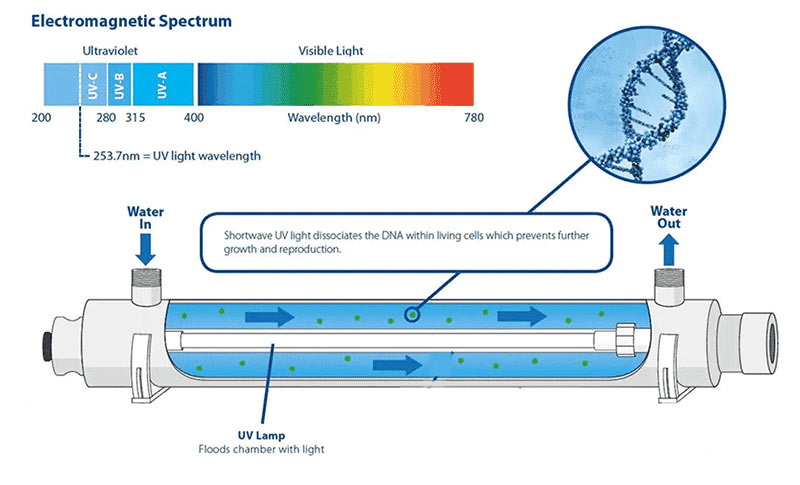
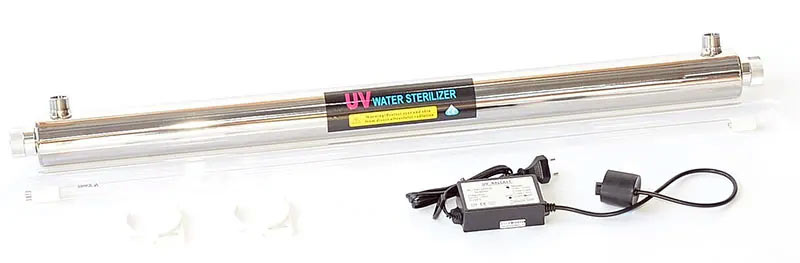
Unfortunately chlorination presents a bit of a problem here: while it does eliminate all microbes, it also significantly reduces the service life of the active carbon filter, since the active carbon absorbs the chlorine along with all the other unwanted smells and flavours. A better (but more expensive) alternative to using chlorine is a water sterilization unit that uses ultraviolet (UV) light.
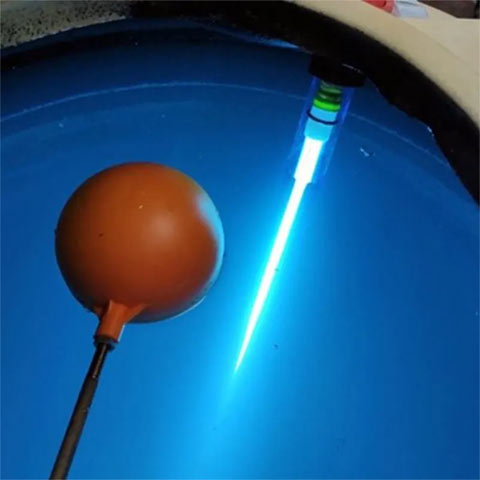 These systems come in two forms: a UV light that is placed inside the
water tank, or an in-line system that is inserted into the water pipe
so that water flows through it. The costs of both systems are about the
same, although there can be significant differences in price between
various brands and suppliers. However, if you have more than one tank
(or add one later) each tank must have its own UV light, so with more
than one tank an in-line system is the cheaper option. In both cases a
typical UV lights uses about 55 watts, which adds up to a significant
energy consumption since the light must be on 24/7. (If you have solar
power this will be far less of a consideration, of course.) The service
life of the UV globe (which is typically a tube rather than a globe) is
about a year, so one must factor in the annual replacement costs. However,
UV sterilization eliminates the cost (and hassle) of regular chlorine
additions to the tank, and it can easily double or triple the service
life of Active Carbon filter cartridges, which makes it affordable to
filter and sterilize all the water that comes into the house and ensures
that the water used for showering, cooking, washing dishes and clothes
etc. is of perfect quality.
These systems come in two forms: a UV light that is placed inside the
water tank, or an in-line system that is inserted into the water pipe
so that water flows through it. The costs of both systems are about the
same, although there can be significant differences in price between
various brands and suppliers. However, if you have more than one tank
(or add one later) each tank must have its own UV light, so with more
than one tank an in-line system is the cheaper option. In both cases a
typical UV lights uses about 55 watts, which adds up to a significant
energy consumption since the light must be on 24/7. (If you have solar
power this will be far less of a consideration, of course.) The service
life of the UV globe (which is typically a tube rather than a globe) is
about a year, so one must factor in the annual replacement costs. However,
UV sterilization eliminates the cost (and hassle) of regular chlorine
additions to the tank, and it can easily double or triple the service
life of Active Carbon filter cartridges, which makes it affordable to
filter and sterilize all the water that comes into the house and ensures
that the water used for showering, cooking, washing dishes and clothes
etc. is of perfect quality.
Practical Considerations
The first question many will ask is whether or not it is possible to stop using municipal water altogether. It may be, but there are a few things to keep in mind. Firstly, the size of the household and the amount of water consumed will be a factor, as well as the amount of space and budget available for tanks. Secondly, while Munster may receive an average of about 100mm of rain per month (see above) this is an average. There will be rainy months (more than 300mm in January to April is typical) and dry months (June to August) with only a little rain or none at all. Being able to get through the dry season requires that the tanks can store at least three months of water and preferably more. There are also wet years and dry years, especially with climate change and the El Niño phenomenon affecting rainfall patterns. Without municipal water as a backup, the cost of tanker water can quickly escalate during a long dry spell.
Then there is the cost of installation and maintenance. Most people will want to use a contractor to install a rainwater harvesting system. Unfortunately the Great South African Contractor (a common species found in bakkies throughout the country) comes in many varieties, not all of which are perfect for the job since there are many skills required here.
Then there is the cost of installation and maintenance. Most people will want to use a contractor to install a rainwater harvesting system. Unfortunately the Great South African Contractor (a common species found in bakkies throughout the country) comes in many varieties, not all of which are perfect for the job since there are many skills required here.
- Capacity planning:
The most economic tank size is 5000 litres. A tank half that size will cost more than half as much; a tank twice that size will cost more than twice as much. However, one tank will often overflow during a good downpour and then run dry a week or two later, depending on typical water usage. So one can’t really have enough tank space to capture as much as possible during the wet season and get as far as possible through the dry season. On the other hand, over-investing in too many tanks is just a waste of money, keeping in mind that more tanks also require more space, more plumbing and more maintenance. - Building:
Tanks have to be placed on a strong, stable and level foundation. All tanks must be on the same level, and a full 5000 litre water tank weighs more than two double-cab bakkies so the foundation must be able to support that weight. - Wiring/plumbing:
The installation involves considerable amounts of plumbing, which has to be done properly in order to avoid domestic disasters. The wiring must be 100% safe. especially given the combination of electricity and water. - Filtration:
The finer points of water filtration and purification often fall well outside the expertise of the average contractor. - Maintenance:
The placement of the tanks, and which portion of the roof they receive their water from, may have significant effects on the amount of contaminants that end up in the tank. The tanks will have to be cleaned out periodically, but whether this is required once every few months or once every year (or two) entirely depends on the orientation of the building and the situation around it.
Another issue that requires careful thought is when, how or even if the capital outlay for a rainwater harvesting system will pay for itself. Depending on the household, typical water consumption, available space and budget the optimum balance between capital outlay and municipal water savings must be worked out. However, saving money is not always the point here. There are other important considerations as well:
- Better water quality:
Water purification plants remove only common contaminants, but not the heavy metals, pesticides and chemical pollutants that are to some extent present in the raw water from sources upstream of the catchment areas, dams and rivers from which the water is drawn. The rain water that enters our area straight from the ocean is of a much better quality even before filtration and purification. - Less dependence on municipal water:
The municipal water supply has become increasingly unreliable over the years. By now we have become accustomed to having municipal water available only one day a week, if we are even that lucky. Having one or two backup water tanks is no longer optional these days, but even having the tanks periodically refilled from the municipal supply is by no means guaranteed. - Not having contamination from failing water infrastructures:
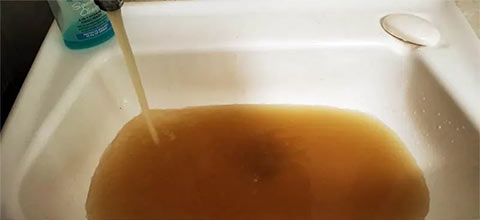
Due to a lack of planning, lack of maintenance, mismanagement, crime and incompetence our water distribution network has fallen apart and is curretnly being held together with sticky tape and paper clips. This often leads to mud rather than water coming out of our taps. - Not paying for air:
Our water meters contain a small paddle wheel that spins when water flows through the meter. Unfortunately this system is designed to measure the flow of water, not air. In air the wheel spins much faster, and after every water outage there is a lot of air in the pipes that has to be blown out through the meter before water can be delivered again. As a result, impossibly high water bills have become common without any actual water being delivered. Challenging this overcharging can be, well, challenging, and the municipality typically places the burden of proof on the consumer. - Sustainability:
Water drawn from dams, rivers and catchment areas has an environmental impact, as does the need to process that water in a municipal water plant. While rainwater harvesting is also not 100% free of environmental effects (tanks, pumps and other components have to be manufactured, transported and eventually recycled, and pumps and UV sterilizers use energy) the environmental balance of rainwater harvesting is a lot more positive than municipal water consumption.
In short, there are a lot of reasons to harvest rainwater, and few reasons not to do it. Depending on your individual situation, options and budget it is possible to start with a small installation and gradually add to it, provided that one plans for future extensions (e.g. when pouring the slab for the tanks’ foundation). If one has the proper skills this can also be a great DIY project, in part or in whole, which helps to save a bundle.