Monkey Business
By Lauren and Frank van Wensveen
The KwaZulu-Natal South Coast is known for its vervet monkey population. Vervet monkeys are a staple of life in these parts. Some of us love them; some of us hate them, and some would even prefer to eradicate them as a pest. To each their own, and this article is definitely not intended to restart the often heated debates between monkey lovers and monkey haters. There are subjects on which we simply have to agree to disagree.
Whether you love or hate monkeys, they are a permanent and inescapable (albeit sometimes frustrating) part of life at the South Coast. However, knowing a little more about these amazing creatures and observing a few simple, basic rules can make it much easier to live with them.
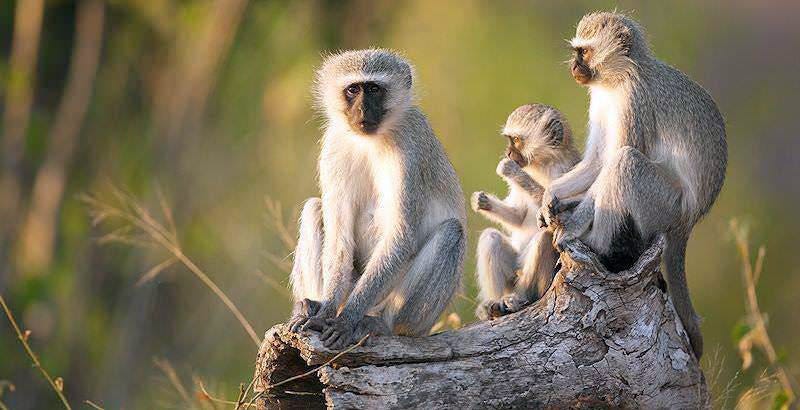
Our monkeys are undeniably cute. Especially the little ones can be adorable. On the other hand, they can also be a real pain! Over the years we've all had our bread stolen, cereal strewn all over the house, groceries plundered, plastic bags ripped to shreds and rubbish spread across our driveways. Some of us have even been attacked by aggressive or frightened monkeys. While this may upset us occasionally, one should keep in mind that this is essentially a man-made problem.
Under completely natural circumstances vervet monkeys breed seasonally, giving birth only during those times in the season when food is abundant. Troops mostly consist of adult females and infants. They are led by dominant matriarchs, while adult males tend to move between troops. The dominance of the matriarch within the troop means that most (although not all) babies are born from dominant females.
Unfortunately our presence has disrupted this natural pattern, because vervet monkeys now have access to copious amounts of human food. Not only is this food available year-round, but the presence of cooked starches and carbohydrates makes this food a lot richer (although not nearly as healthy!) than the monkeys' natural diet. As a result of this, all females within a troop are now typically breeding all the time, and usually at a far younger age than is normal. In some areas this has caused the monkey population to explode.
Monkeys live off the land. They always have. The fact that we now have built our houses on that land makes no difference to them; they have simply adapted to it. Because the trees they used to sit in have now been replaced with our houses, they now sit on our roofs, decks and patio's, still going about their business as usual.
Monkeys are gatherers by nature, so it was inevitable for them to become scavengers, now that they are being presented with so much rich food that is simply there for the taking. Our roads and buildings have also reduced the availability of their natural foods, so they take what they can get. Their natural diet consists mainly of fruits, seeds and vegetation. Thanks to us they have now also developed a taste for bread, cereals and fast food.
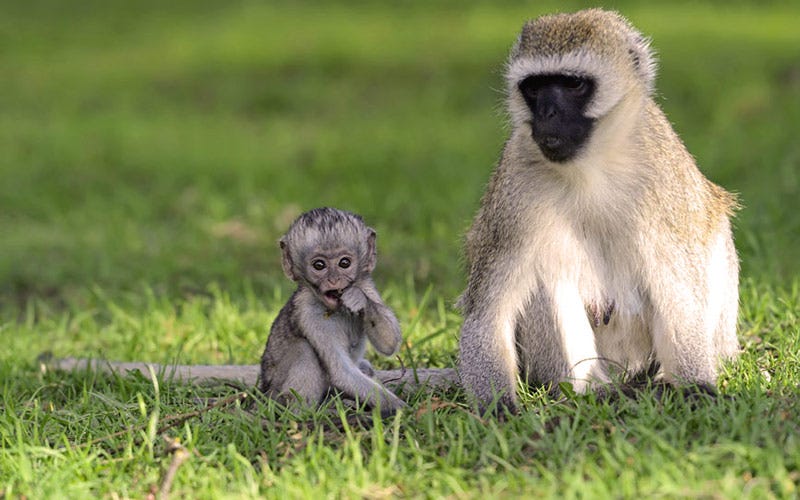
Vervet monkeys behave a lot like people and are quite intelligent. Their "vocabulary" has literally hundreds of different calls and vocalizations. For example, the alarm call they have to warn the troop of a leopard is distinctly different from the one that indicates the presence of a snake. Mothers recognise their offspring by their calls. When an infant calls for help, the mother is typically the first to respond. Other mothers can also determine to which mother the infant belongs, and they tend to look towards the mother whose offspring is calling.
They have a well-developed social structure and strong kin relationships. When an infant is born, every member of the group inspects the new arrival at least once over the following few days by touching or sniffing. Siblings often act friendly and supportive to each another. On the other hand, there are also cases in which siblings simply can’t seem to get along and act spitefully to one another. There are also individuals in most troops who can be aggressive towards others and try to bully themselves into positions of power. They can occasionally become malicious for no apparent reason and often single out individuals within a troop to take this out on. They are one of few animals (other than humans!) to display this type of behaviour.
Unfortunately for us, their intelligence means that they have quickly learned that a lot of rich food can be found around places where humans live or gather, especially in dustbins, plastic bags and of course in houses. They go where the pickings are richest and they exploit every opportunity, just like a human would do!
In other words, monkeys simply behave as is natural to them. While that may at times be annoying to us, classifying them as a pest is doing them an injustice. They are not just pests and food thieves. Vervet monkeys play a crucial role in seed dispersal and without them many plants and trees would suffer or disappear. They also contribute to nutrient recycling and natural soil fertilization through their dung. They are, in short, a part of the ecosystem that cannot simply be eradicated without causing parts of that ecosystem to collapse.
Whether we like it or not, we do share the South Coast (and other parts of the country as well) with the monkeys. This doesn’t have to be a problem. All we have to do is to keep a few simple rules in mind:
- Keep a close eye on children, especially small children, when they have food with them. The larger male monkeys can become quite aggressive when trying to get food, and won’t hesitate to confront a child who’s carrying fruit or eating lunch.
- Do not approach, tease or scare monkeys and don't try to corner or catch them. When confronted with what they perceive as a threat they will defend themselves, in which case they may attack you. Making sure the monkeys see you looking at them is usually enough to keep them away. If they try to intimidate you (especially the males may try to bully you!) simply stay calm, keep your distance, stare them down, stand your ground and show that you are not afraid of them. At that point they will usually give up and eventually move on. Remember that they are only after food and safety for themselves and their offspring.
- Whatever you do, NEVER FEED MONKEYS. This only makes the problem worse. Monkeys will return to places where they have found food before, hoping to find more. If you make sure they can't smell or see any food in and around your house, they will have no reason to come near it. By making food available to them or feeding them you will attract them, and that may soon become a serious problem. Human food is also quite detrimental to their health and distracts them from their balanced natural diet. To feed them is to harm them. Keep all foods away from them as much as possible.
Simply put: monkeys are wild animals, so treat them as you should treat any other wild animal, i.e. with respect and caution. Enjoy them from a safe distance. Above all: expect them to do what comes to them naturally, even if means they will act as a gatherer and try to make off with your lunch. They are a staple of life at the South Coast, so plan accordingly, and everything should be fine.
More information on our monkeys is available at the Monkey helpline.
Also see the Wildlife Management Vervet Monkey Technical Guide from Ezemvelo KZN Wildlife.