Trees that rain?
By Lauren van Wensveen
Every year in September and October, you may notice that under some of the larger trees it appears to be raining - even when the sky is clear! Interested to know what's causing it? Read on to find out...

The "rain" is actually a dripping liquid (spittle) formed by Rain Tree Spittlebugs (Ptyelus grossus). Immediately after hatching, the nymphs of these little bugs use their sucking mouth parts to start feeding on tree sap. As this sap is low in nutrients, they drink huge amounts of it and process it rapidly through their bodies. Using special abdominal chambers to pump and trap air into the mixture, they create a stable, frothy spittle foam in which they completely insulate themselves.
This foam is a mixture of tree sap and spittlebug secretions, consisting mainly of sugars and salts. It protects the nymphs from heat, helps them retain moisture, and protects them from predators. Although the adults are usually solitary, the nymphs feed in large groups and continually produce spittle, which results in the constant dripping or 'rain' under the trees that you may have noticed. They remain in their foamy protective bubbles for about 30 to 60 days before emerging as flying, hopping adults.
Adult rain tree spittlebugs have strong hind legs and can jump significant distances relative to their body size. They are widely distributed throughout the whole of South Africa, except for the arid mid-southwestern Cape.
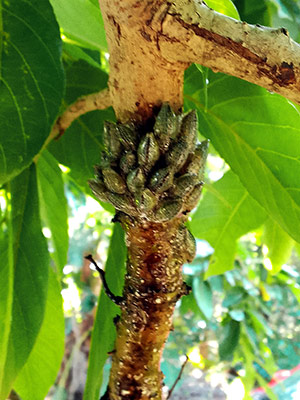
Rain-tree spittlebug nymphs and adults display different shades of colours ranging from pale yellow and green to grey, tan and even bright yellow. This colour variation aids in camouflage, allowing them to blend into their environment and hide from predators.
So do you need to worry about rain tree spittlebugs? The answer is NO!
- The foamy spittle is non-toxic and will not harm humans or animals;
- They use certain fungi and bacteria to assist them with breaking down organic material which, when excreted in the dripping spittle, helps with enriching the soil and contributes to nutrient cycling in the ecosystem;
- They are food for a large number of birds and other insects such as ladybugs;
- As they are sucking sap, their feeding may stimulate plant growth and health;
- Despite the heavy dripping, the feeding process rarely causes real or lasting damage to healthy host trees;
- Their presence and abundance can indicate the health of an environment, which makes them useful for ecological monitoring;
- In short, their role is to maintain ecological balance.
So if you haven't yet noticed the raining trees this year, look out next year for the evidence of the next batch of feeding rain tree spittlebug nymphs!
(Photos taken at Highland Ave., Munster)